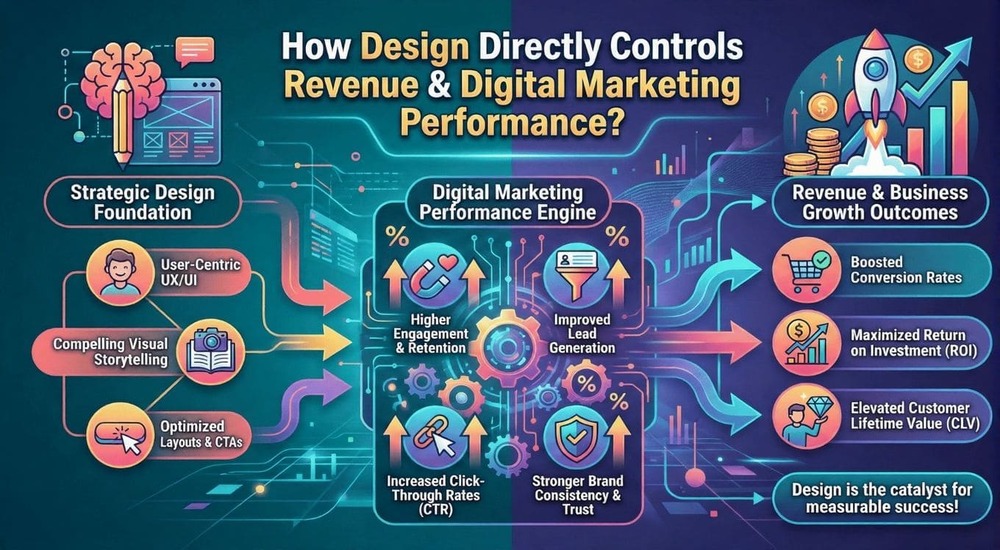
UI/UX is conversion infrastructure, not cosmetic styling. Every website interaction is a measurable behavioural event. The structure either accelerates decision-making or destroys intent. Digital marketing campaigns depend on predictable conversion environment. Without engineered experience architecture, paid traffic leaks and organic visibility weakens. Ads can purchase visibility, not output. UX determines output.
Conversion is not persuasion. Conversion is reduction of friction. Unstructured design increases cognitive load, disrupts flow, and encourages exit behaviour. Structured design directs movement, reduces uncertainty, and increases action.
Search engines track user engagement patterns. Bounce rate, dwell time, scroll depth, and interaction events reinforce or degrade ranking. UX influences these metrics, therefore influences SEO value and paid advertising returns. Digital strategy is executable only when UX infrastructure converts demand into measurable actions.
UI/UX defines conversion probability
Design organizes logic. UX organizes the journey. Users follow predictable behaviour patterns. When pathways break, intent collapses. Decision time requires clarity. Cognitive strain forces abandonment.
Conversion-optimized UI/UX includes:
Immediate clarity of purpose
Obvious action targets
Minimal text per decision
Consistent hierarchy
Predictable navigation patterns
Optimized spacing and typography
No dead ends, no confusion
Digital marketing delivers traffic. UX decides the fate of that traffic.
Attention operates under scarcity rules
Users do not analyse. Users react. Eight seconds decide fate. Friction kills momentum. A website must function like a directed pipeline. Every element must instruct silently. Every scroll must reinforce direction. Every CTA must appear exactly when readiness peaks.
Strong UX reduces decision steps, increases task completion, stabilizes attention, lowers resistance, and increases trust.
UI/UX controls perception of credibility
Trust is visual before it is rational. Users judge legitimacy inside the first second. Visual alignment, spacing discipline, and readability determine trust signals. Credibility increases conversion probability. Digital marketing ROI increases only when trust exists before persuasion begins.
Credibility indicators:
Strong typography hierarchy
Decluttered interface
Consistent layout rhythm
Proof placement near friction points
Motion discipline without distraction
The opposite: random placement, ornamental visual noise, exaggerated styling, and unstructured communication destroy trust instantly.
UX determines routing efficiency
Conversion outcomes depend on movement direction. Users must reach intended goals via shortest path. Excess steps increase abandonment exponentially. UX routing determines revenue capacity.
Critical routing principles:
Primary CTA always visible or reachable in one gesture
Secondary options reduced
Exit points replaced with progression options
Decision complexity minimized
Data capture forms optimized for minimal fields
Digital strategies require measurable funnels. UI/UX constructs those funnels.
UX engineering reduces marketing cost
Digital advertising cost penalizes inefficiency. Platforms track post-click engagement. Weak UX signals irrelevance and increases CPC. Strong UX boosts relevance and reduces cost.
Behavioural signals Google evaluates:
Immediate exit rate
Depth of interaction
Conversions per view
Engagement events
Better UX increases these metrics, therefore increases performance distribution and reduces cost.
UX impacts organic visibility
SEO is no longer keyword plus content. Experience quality affects ranking strength. Google Core Web Vitals measure real-world usability. UX structure changes scoring outcome.
Ranking-critical UX signals:
Largest Contentful Paint timeframe
Layout stability
Interaction readiness metrics
Bounce and dwell patterns
Organic ranking depends on UX stability. Weak UX reduces search visibility regardless of content quality.
UI/UX increases lifetime value
Retention is conversion repetition. Well-engineered experience increases comfort, familiarity, and emotional efficiency. Increased retention reduces lead dependency, lowering marketing cost. Business stability increases.
UX shapes brand perception
Experience is brand. Interface communicates identity. Every element expresses clarity or confusion. Brand loyalty emerges through consistency. Poor UX communicates carelessness.
Digital marketing outcomes depend on UX maturity
Without UX engineering:
Ad spend waste increases
Conversion cost inflates
Lead quality perception declines
Brand trust weakens
Organic reach plateaus
With engineered UX:
Higher conversion per visitor
Lower CPC and CPA
Faster scaling cycles
Stronger search visibility
Reduced dependency on paid ads
Marketing success is architectural, not promotional.
UX intelligence is data-driven science
Experience design requires measurement. Analytics determines direction. Testing validates architecture. Decisions require proof, not preference.
UX optimization framework:
Measure behaviour flow
Identify friction points
Restructure pathways
Validate with A/B testing
Repeat optimization cycles
Without data discipline, UX remains guesswork.
Integrated digital performance system
UI/UX, content structure, technical performance, and marketing channels must operate as a single system. Fragmented approach guarantees inefficiency. Unified approach guarantees predictable revenue outcomes.
Integrated system requirement:
UX defines journey
Content supports intent
Speed supports flow
Design supports clarity
Marketing activates prepared structure
The website becomes revenue machinery rather than a digital brochure.
Final synthesis
UI/UX is conversion engineering, not art. Experience design controls every measurable outcome in digital marketing. Campaigns require infrastructure before promotion. Ads require conversion path before traffic. SEO requires UX signalling before ranking. Brand requires design clarity before trust.
Businesses that design for behaviour control markets. Businesses that design for appearance lose the competition cycle. The future of digital strategy belongs to engineered experience, not decorated interface.
