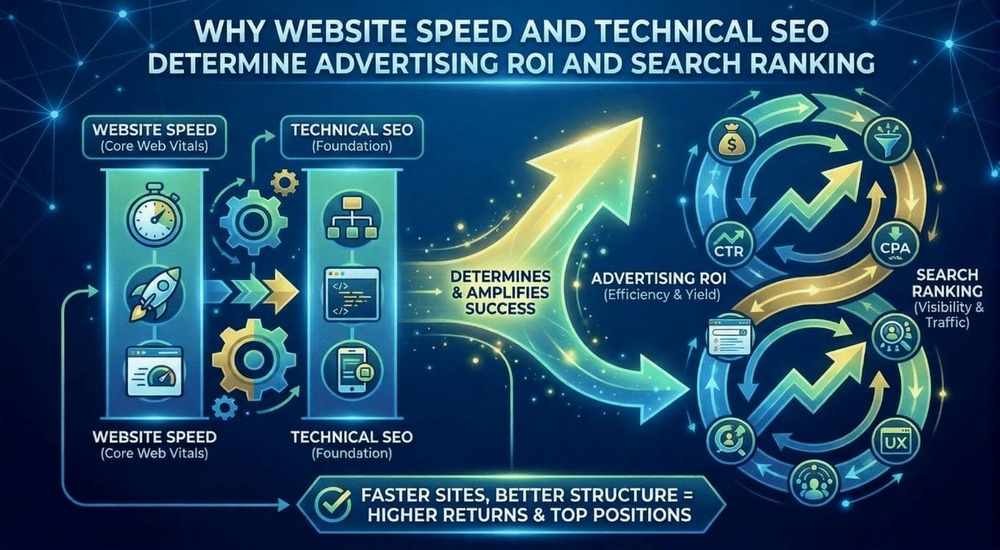
Website speed is economic infrastructure. Technical SEO is structural engineering. Together, they control discoverability, conversion efficiency, advertising profitability, and long-term ranking stability. Digital marketing cannot compensate for performance defects. No campaign can outperform a slow, unstable, technically weak website. Budgets collapse when infrastructure rejects demand.
Speed is the first conversion checkpoint. Users exit immediately when loading stalls. Search engines track exits and drop ranking. Paid advertising platforms penalize landing pages that fail to sustain engagement. Slow websites inflate acquisition cost, destroy ROI, and signal irrelevance. Technical SEO determines whether pages can be crawled, indexed, and interpreted. Without technical integrity, visibility declines independent of content quality or marketing volume.
Speed determines survival in the attention economy
Users behave under extreme impatience. Two seconds defines tolerance. Each additional second cuts conversion probability. Experience is judged instantly. Visitors punish friction by abandonment. Lost attention cannot be recovered.
Slow performance results in:
Abort before first interaction
Reduced scroll depth
Low engagement metrics
Algorithmic penalty
Campaign inefficiency
Speed is not aesthetic preference. Speed is revenue capability.
Speed signals relevance to search engines
Google Core Web Vitals quantify user experience. Performance metrics are ranking signals. Search engines evaluate real-world interaction, not theoretical capability. Websites that load quickly and behave predictably outperform heavy, unoptimized experiences regardless of design complexity.
Core performance indicators:
Largest Contentful Paint
First Input Delay
Cumulative Layout Shift
Interaction readiness
Server response stability
Improvement of these scores directly correlates with ranking elevation and visibility growth.
Speed protects advertising investment
Paid ads purchase attention. The landing page must convert that attention. If loading collapses, money evaporates. Quality Score in Google Ads depends heavily on user experience behaviour after the click. Poor performance increases CPC and reduces impression priority. High-performance pages reduce cost and increase distribution.
Speed-driven advertising outcomes:
Lower cost per click
Higher click-through retention
Higher conversion efficiency
Improved relevance scoring
Stronger placement priority
Advertising ROI is mathematically tied to speed.
Technical SEO determines discoverability
Technical SEO constructs the crawl and indexing framework. It governs how search engines understand architecture and assess accessibility. Without technical integrity, organic ranking collapses regardless of content quality.
Core technical structure:
Clean, logical URL hierarchy
XML sitemap accuracy
Robots governance
HTTPS security compliance
Structured schema data
Server stability
Error-free index pathing
Search engines prioritize system quality. Weak architecture equals invisibility.
Technical SEO governs crawl budget efficiency
Search engines allocate limited crawl time per website. Wasted cycles reduce index depth and visibility.
Crawl waste sources:
Heavy scripts
Bloated page weight
Redirect loops
Broken internal linking
Efficient architecture improves discovery and organic performance.
Technical SEO links directly to content value
Content is visible only if architecture supports it. Google does not rank what it cannot interpret. Structured data clarifies meaning and improves entity understanding. Hierarchical logic strengthens semantic mapping. Technical discipline determines whether search engines can correctly evaluate topical value.
Speed and technical SEO control behavioural ranking signals
Search engines measure user reaction. Performance determines behaviour. Behaviour determines ranking direction. This is measurable mechanics, not subjective theory.
Critical behavioural indicators:
Bounce rate
Return-to-result action
Session duration
Scroll patterns
Interaction willingness
Positive signals trigger ranking elevation. Negative signals degrade visibility instantly.
Speed and technical SEO reduce dependency on paid channels
When organic strength rises:
Traffic increases without direct cost
Acquisition price drops
Retention increases
Revenue stabilizes without constant reinvestment
Performance excellence converts marketing into acceleration instead of compensation.
Performance engineering improves credibility perception
Trust is established before content delivery. System responsiveness communicates competence and reliability. Lag communicates disorder and neglect. Brand perception forms in milliseconds. Credibility increases conversion probability without persuasion effort.
Speed improves conversion psychology
Fast systems reduce cognitive resistance. Slow systems increase frustration. Micro-interruptions trigger exit behaviour. Fluid interaction accelerates movement toward goal completion.
Conversion improvements driven by speed discipline:
Improved form completion
Stronger call-to-action readiness
Higher post-click engagement
Lower abandonment
Performance is psychological engineering.
Performance defines mobile capability
Mobile traffic dominates. Mobile infrastructure punishes heavy assets. Mobile interaction requires compressed execution and minimal weight. Mobile-first indexing prioritizes real-world loading on portable networks. Performance compliance equals ranking advantage. Failure equals exclusion.
Performance optimization principles
Cut weight. Reduce complexity. Prioritize function over decoration. Remove code excess. Segment delivery intelligently. Compress assets aggressively. Replace dependency layering with structural discipline.
Execution pillars:
CDN distribution
Lazy loading
Minified resources
Server-level caching
Image optimization
Code refactoring
Clean architecture
The goal: instant interaction availability.
Convergence: Speed + Technical SEO + Digital Marketing
Marketing without infrastructure is loss. Infrastructure without marketing is latent potential. Integration creates scalable revenue.
Unified outcome structure:
Speed maintains engagement
Technical SEO ensures visibility
Marketing activates demand
Conversion engineering captures value
Fragmented execution guarantees inefficiency. Integrated execution guarantees exponential scaling.
Final synthesis
Speed is non-negotiable. Technical SEO is foundational. Advertising ROI depends on both. Organic ranking depends on both. Brand credibility depends on both. Campaign performance depends on both. Revenue growth depends on both.
Businesses that engineer performance dominate competition. Businesses that ignore performance overpay forever and lose visibility.
